Climate metrics data, by
API or cloud delivery.
Get emissions and climate risk data into your own systems, with help to set it up the way your team works.
Talk to our data integration experts

Get emissions and climate risk data into your own systems, with help to set it up the way your team works.
Transparent, documented methodology across every holding.
Public and private assets (including any company) across emissions, transition, and physical risk.
Results in seconds.
RESTful API
Integrate through the RESTful API, with outputs returned in seconds.

Developer documentation to start building
Process hundreds of holdings in seconds
All asset classes and risk scenarios
Explore outputs in the demo application
Snowflake
Data shares deliver public universe data, ready to use. For portfolio data already in Snowflake, the Native App processes it in place, and covers private companies too when you provide their industry, location, and a financial metric.
Portfolio stress testing and scenario analysis
Secure in your Snowflake environment
Batch-process thousands of companies securely

Climate Risk and Emissions by Emmi runs as a Snowflake Native App, processing your portfolio data where it already sits. It returns emissions and climate risk for any company, public or private, when you provide their industry, location, and a financial metric, and it includes geospatial hazard data.
Prefer ready-made data? Direct data shares deliver public universe emissions data on its own, or emissions and climate risk data together, with no processing needed on your side.
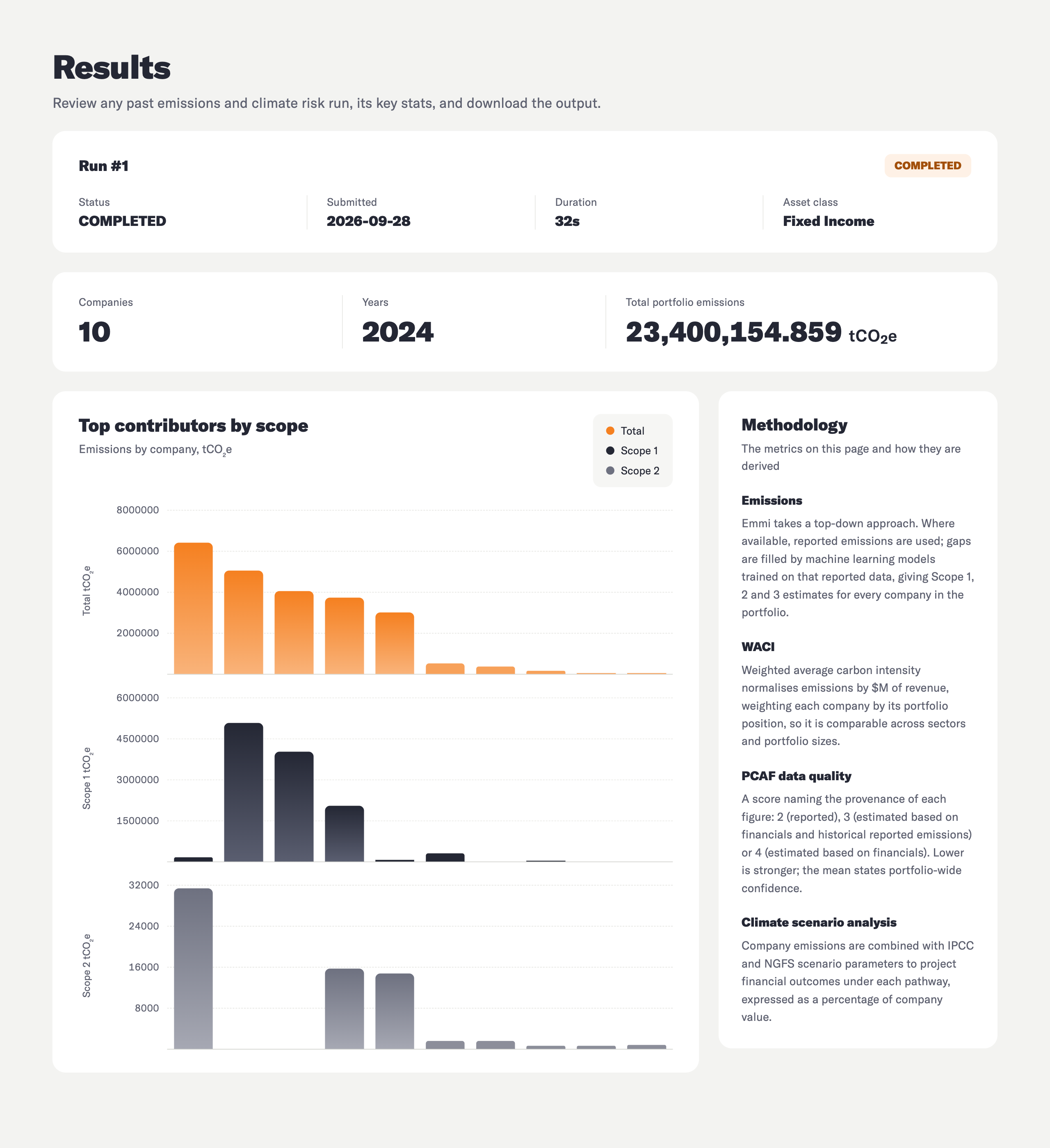
Climate Risk and Emissions by Emmi
Test the app on a sample of your own portfolio with a Snowflake Marketplace trial.
If a platform your team already uses carries Emmi data, you can access it there, with no integration work. Can't find your platform? Tell us which one you use, and we'll make the case for adding Emmi data.
Talk to us about the setup that works for your systems.