Financed emissions.
Scope 1, 2 and 3, across public and private markets.

Emmi combines reported emissions data with machine learning to deliver Scope 1, 2, and 3 coverage across public equities, fixed income, private equity, private debt, property, infrastructure, and unlimited custom coverage.

Talk to our data experts

Reported data first. Machine learning fills the gaps.

Emmi draws on verified reported emissions from public companies as its primary source. Where reported data isn't available, machine learning models trained on 10,000+ public companies calculate company-level emissions, capturing the non-linear relationships between sector, geography, and scale that factor-based approaches miss.

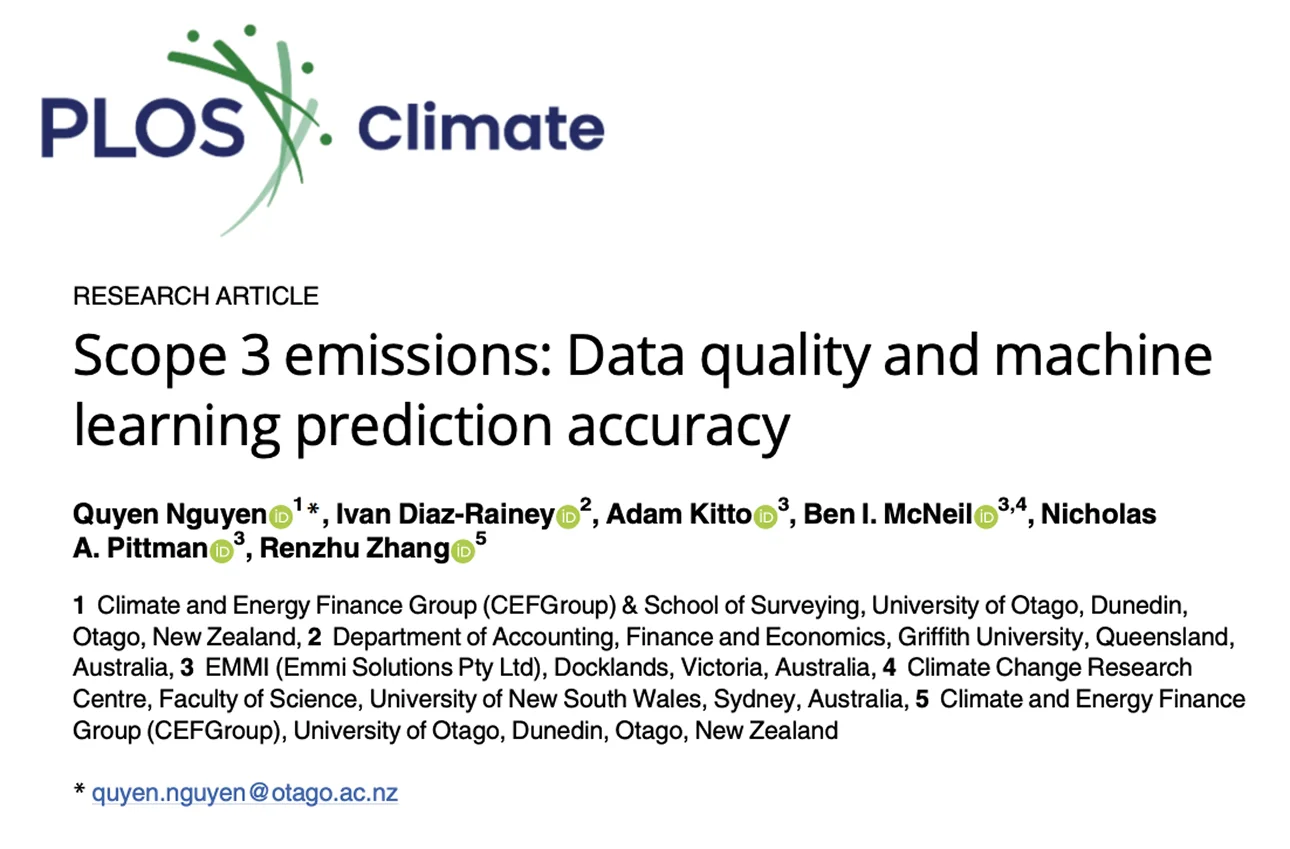
Read the PLOS Climate paper

UP TO

30%

MORE ACCURATE

In peer-reviewed research, the machine learning approach behind Emmi's models was up to 30% more accurate than traditional revenue-based emission factors.

Every number carries a data quality score.

A financed emissions figure built partly on disclosure and partly on estimates is only useful if you can tell which is which, and how confident the estimate is.

Every data point carries a PCAF data quality score, on the same 1 to 5 scale your reporting already uses. Scores aggregate up to sector, asset class, and investment manager level, so you can see where the weakest data sits in your portfolio rather than reading a single blended figure.

Coverage that reaches

all assets, including
private markets.

Emmi calculates financed emissions across all asset classes. For private market assets with limited disclosure, machine learning models can generate emissions estimates from three inputs: industry, location, and one financial metric, such as revenue or total assets.

Private markets

Fixed income

Private equity

Property

Infrastructure

Any company or asset (custom coverage)

Financed emissions, from asset level up.

Scope 1, 2 and 3 in tCO2e, at asset level

Attributable and total financed emissions, aggregated to fund, asset class, and total holdings

EVIC-based attribution factor, the PCAF-aligned basis for ownership share

PCAF data quality score on every data point

Comparing holdings of different sizes.

Absolute emissions scale with the size of a holding, so a large low-carbon position can look worse than a small high-carbon one. Intensity metrics normalize for size, which is what makes companies comparable against each other and against their sector.

Weighted average carbon intensity (WACI)

The global warming pathway a company or fund is currently on, placed on a 1.5°C to 4°C spectrum using IPCC AR6 carbon budgets scaled to company size.

Weighted average carbon intensity (WACI)

This is some text inside of a div block.

Weighted average carbon intensity (WACI)

The global warming pathway a company or fund is currently on, placed on a 1.5°C to 4°C spectrum using IPCC AR6 carbon budgets scaled to company size.

Weighted average carbon intensity (WACI)

The global warming pathway a company or fund is currently on, placed on a 1.5°C to 4°C spectrum using IPCC AR6 carbon budgets scaled to company size.

Weighted average carbon intensity (WACI)

The global warming pathway a company or fund is currently on, placed on a 1.5°C to 4°C spectrum using IPCC AR6 carbon budgets scaled to company size.

Weighted average carbon intensity (WACI)

Holdings-weighted intensity. The standard portfolio metric from TCFD, still widely used in disclosure.

Revenue intensity

Emissions per unit of revenue, measuring the carbon efficiency of operations.

EVIC intensity

Emissions per unit of enterprise value including cash, using the same EVIC denominator PCAF uses for attribution.

What a company says. What the data shows.

Emissions and transition risk don't stay fixed. Targets show where a company says it's headed. Forecasts show where its actual behavior suggests it's headed. Both extend the baseline picture with a forward view, not just where things stand today.

Scope 3 is under-reported by up to 44%.

Emmi research published in PLOS Climate found companies under-report Scope 3 emissions by up to 44%. The missing emissions run into billions of tonnes, concentrated in the most material categories. Emmi's machine learning approach is designed to correct for this.

Read the PLOS Climate paper
Emmi research on Scope 3 under-reporting, published in PLOS Climate

Request access to our detailed methodology documents

Related reading

up

Further information:

close