Targets.
Do science-
based targets reduce your transition risk?

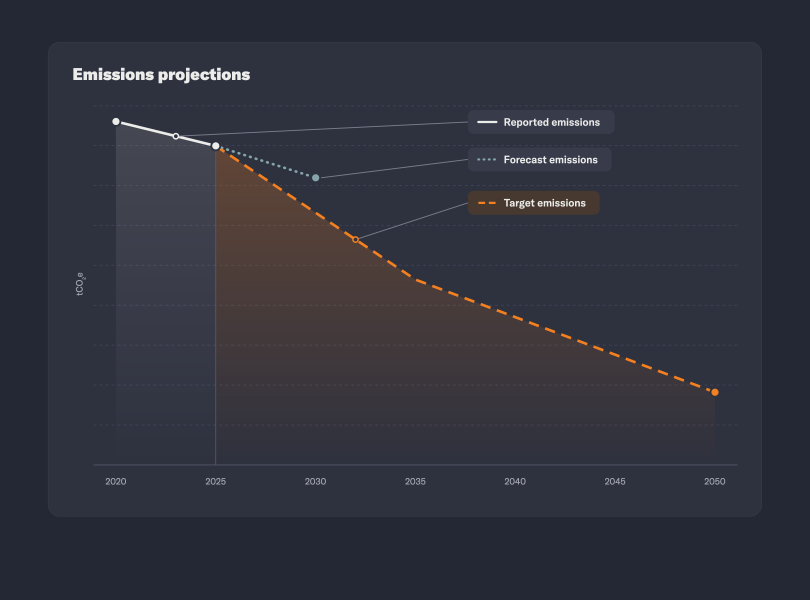
Emmi convert SBTi-validated absolute reduction commitments into emissions trajectories, then recalculate Transition Value at Risk (TVaR) to show how much risk falls if a company delivers.

Talk to our data experts

Published commitments, converted into numbers.

Target-aligned emissions trajectories, by Scope

Recalculated Transition Value at Risk (TVaR)

Remaining reduction requirements after targets are met

Temperature alignment under the target-achieved pathway

Business-as-usual comparison, side by side

Full source identifiers, versioned for traceability
Add TVaR to PVaR and you get CVaR: one number for total climate exposure

What target data answers.

Add TVaR to PVaR and you get CVaR: one number for total climate exposure

Full, partial or failed delivery

Model the target as fully achieved, partially achieved, or missed, and see how TVaR moves in each case, calculated against the company's own baseline. The spread across those outcomes is where the risk sits.

Target strength across sectors and regions

Compare target coverage and strength across sectors and regions, on a consistent scenario-adjusted basis. The gaps show where commitments are concentrated, and where they're largely absent.

Where stewardship changes the outcome

Rank every holding by how much TVaR would fall if its target were delivered. The holdings with the largest fall are where stewardship conversations matter most.

From published target to a trajectory.

We use each company's own reported emissions, weighting recent years more heavily, to estimate a direction and a typical year-to-year variability by Scope. That runs through a Monte Carlo simulation to produce a median emissions level and an explicit uncertainty band, rather than a single point forecast.

Companies without at least three years of clean reported data, or whose recent behavior is too volatile to model reliably, aren't force-fit into a forecast. Accuracy is highest for larger companies, whose emissions and reporting tend to be more stable. We'd rather flag a gap than publish a number that implies more confidence than the data supports.

Chart of a company emissions forecast with its median path and uncertainty band

How do you tell if a target is achievable?

A target is a statement of intent. Whether a company gets there depends on what it has actually been doing, and the two often diverge.

Emissions forecasts are built from observed behavior alone, with no reference to any stated commitment. Run alongside the target trajectory, the gap between them tells you whether the target is supported by the trend.

How much of your transition risk disappears if a target is met?

We modeled 4,053 absolute reduction targets matched to 1,775 companies, covering close to 20% of global public equity emissions.

One finding stood out. A.P. Moller-Maersk's transition risk tells two different stories depending on which pathway you use. On a business-as-usual basis, TVaR stays material across every scenario. Modelled against its own published targets, TVaR falls to effectively zero in every scenario except IPCC Net Zero 2050. The difference between those two results is the risk that corporate delivery, not disclosure, would remove.

Backed by our research.

Cover of The future isn't static white paper

The future isn’t static

How Science-Based Targets change forward-looking transition risk, and how much disappears when a company delivers on them.

Request access to our detailed methodology documents

Related reading

Further information:

up
close